'It's too warm': Greenland's fishermen are under threat from climate
change
[March 04, 2026] By
EMMA BURROWS, KWIYEON HA and EVGENIY MALOLETKA
ILULISSAT, Greenland (AP) — Fisherman Helgi Áargil no longer knows what
to expect on Greenland 's fjords, where he spends up to five days at a
time on his boat with his dog, Molly, and the ever-changing northern
lights in the sky as company.
Last year, his boat got stuck in ice that broke off the nearby glacier.
This year, it's been very wet instead. His income is just as
unpredictable. An outing could bring him around 100,000 Danish kroner
(about $15,700), or nothing at all.
The Arctic's rapidly changing climate is bringing more questions for
Greenland, the semiautonomous territory of Denmark that's been shaken by
U.S. President Donald Trump's interest in owning it.
While Trump's approach to Greenland has shifted, the world has been
unable to slow the effects of climate change. The Arctic is warming
faster than any other region in the world, driven by the burning of oil,
gas and coal.
What that means for the fishing industry that largely drives Greenland's
economy is unknown. Fishing accounts for up to 95% of exports, many to
the territory's biggest market, China, along with the United States,
Japan and Europe.
Disappearing sea ice
Wrapped in a wool sweater against the freezing wind, Áargil explained
how he fishes for halibut and cod. Other top catches are shrimp and snow
crab, which including legs can reach more than a meter (3 feet) in
length.
Traditional ice fishermen who make up half the local industry are seeing
the most dramatic changes to the way they fish.
“My father was fishing from the sea ice" one and a half meters (almost 5
feet) thick, recalled Karl Sandgreen, head of the Icefjord Center that
documents climate change in the region and is based in the town of
Ilulissat.

That sea ice started disappearing around 1997, Sandgreen said, and
fishermen who drilled through the ice to fish increasingly started to
fish by boat instead. The use of boats allows fishermen to reach larger
areas, but that can come with extra costs and pollution that that
accelerates warming.
Fishing has shaped Greenland's communities. The harbor where fishermen
return to sell their catch is at the heart of every town or village.
Before heading out, some fishermen pick up boxes from the island's
fishing companies to pack their catch which, in the capital of Nuuk, is
winched from the boat to the fish factory.
Toke Binzer, the chief executive of the island’s single biggest
employer, Royal Greenland, said he is increasingly worried about a
future with greatly diminished sea ice. That could push traditional
fishermen toward larger communities and into the ranks of commercial
fishing.

[to top of second column] |
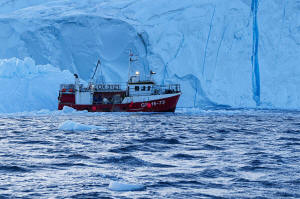
A fishing boat pulls a net up with fish in front of an iceberg at
Disko Bay near Ilulissat, Greenland, on Thursday, Jan. 29, 2026. (AP
Photo/Evgeniy Maloletka)
 The challenge now is how to support
traditional fishermen when there is sometimes “too much ice to sail,
too little to go out on," Binzer said. Already, that
unpredictability has caused a “huge” problem.
Royal Greenland already loans fishermen money to buy a boat, which
they repay from selling their catch, Binzer said.
If everyone turns to fishing from boats, that could help
economically but lead to overfishing, said Boris Worm, an expert in
marine biodiversity at Dalhousie University in Canada.
In Greenland, there are already signs of too much fishing close to
shore as halibut are getting smaller, Binzer said. Worm agreed,
calling it a classic sign of overfishing as the bigger fish are
caught and the smaller, younger ones are left.
That problem could worsen as the retreating ice makes fish more
accessible. Fish stocks could rise as the warmer weather causes
increased rain and melting ice to bring more nutrients for plankton,
which the fish feed on, Worm said.
He warned, however, that the fish may not behave as “predictably,”
as in the past, perhaps by seeking new food sources if they can no
longer feed on the algae which grows under the sea ice.
Few options beyond fishing
On his boat near Nuuk, Áargil considered another challenge: Warm
weather is making some fish harder to catch as they go deeper in
search of colder waters.
“It’s too warm,” he said, looking at the hills around the fjord. “I
don’t know where the fish is going, but there’s not so much.”
Options beyond fishing remain few in Greenland. Tourism is
increasing but far from making up a significant part of the economy.
Tradition, too, is at the heart of worries about climate change.
Already, dog sledders have been confined to land when there is no
sea ice.
“It’s really important for many Greenlanders to have the ability to
go out and sail,” said Ken Jakobsen, the manager at Royal
Greenland’s factory in Nuuk. Fishing is the “most important” thing.
In the capital alone, he said, there are more than 1,000 boats in
the harbor during summer — in a territory where the total population
is little over 50,000.
All contents © copyright 2026 Associated Press. All rights reserved |