|
On Saturday, March 21st, the
Lincoln Heritage Museum in Lincoln hosted a guest speaker whose
topic was the well-known author Harriet Beecher Stowe, author of
Uncle Tom’s Cabin.
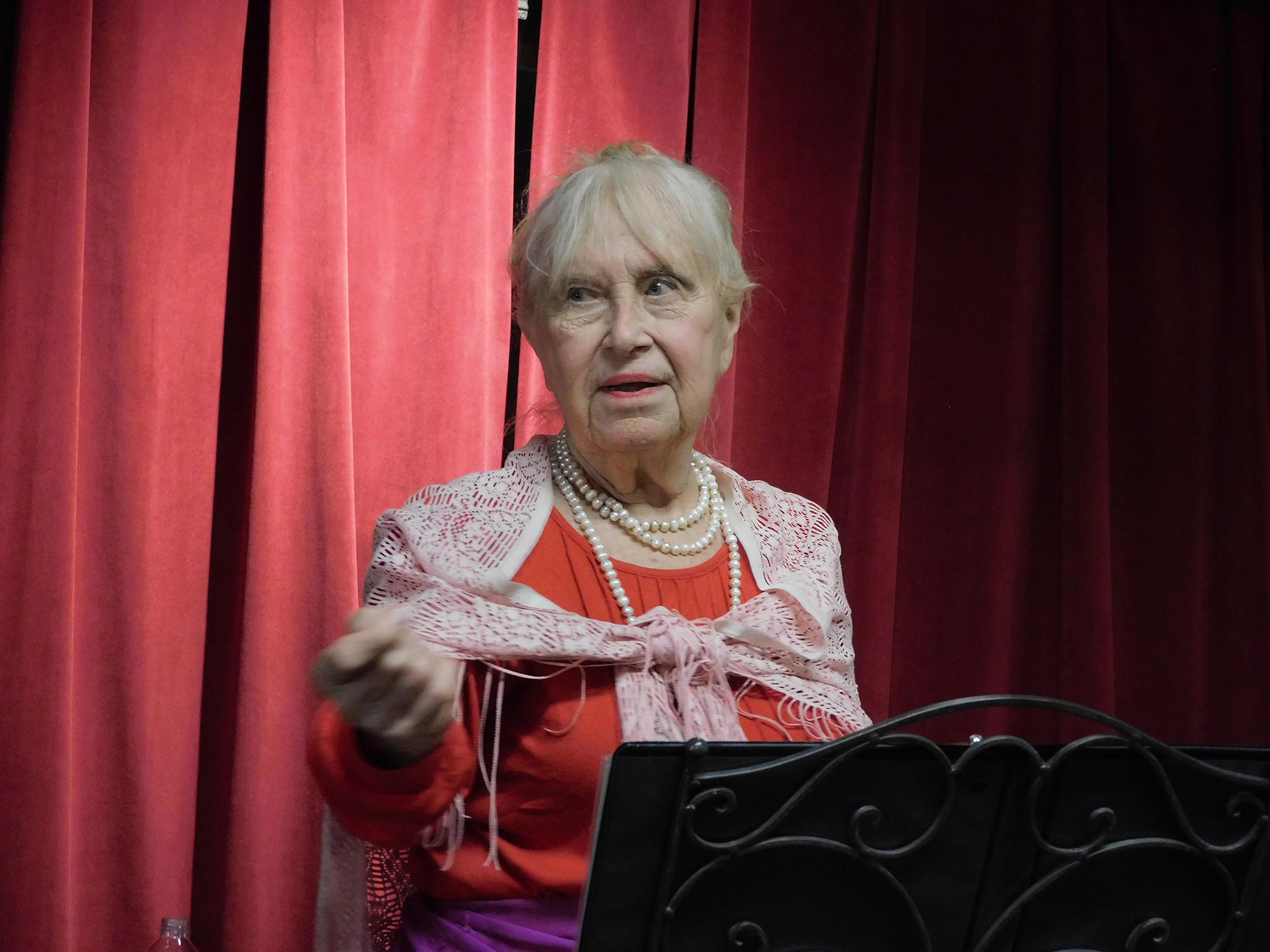
Edith Barnard, accompanied by her husband Wes, spoke first about her
own life and her interest in the famed author. She said that she had
spent time in Bath, Maine in her youth, which was close to the
location that HB Stowe had grown up.
Barnard said like HB Stowe, her
father was in the ministry, and Barnard first took on the persona of
Stowe in 1986 for a church play. She said soon after she was called
upon to repeat the performance in various locations including
Harvard and the Old North Star Church.
Barnard has a Bachelor of Science in Music and a Master in Theater.
She taught both after graduation until she was relieved of her
teaching position because her students were too fond of her. They
would skip other classes to spend time in the music room, mastering
that craft instead of receiving a rounded education.
After teaching, she opened a theater and gave private classes in
music and theater.
Barnard said that throughout her life, she felt that if there indeed
was the possibility of reincarnation, perhaps she had once been HB
Stowe. She said it was brought home to her forcefully when she
visited England. Barnard said at a point during the trip she was
visiting a location with a strong connection to Lord and Lady Byron.
While she was in that location, she started feeling angry and
agitated, and the feeling kept getting stronger and stronger. On the
day of the visit, there was no reason for her to feel this way,
except for the fact that Stowe had felt anger towards the Lord and
had written a book about Lady Byron, which angered the Lord.
When Barnard took on the persona of HB Stowe, her husband Wes was
with her taking on the role of Stowe’s husband Calvin.

Stowe was born Harriet Beecher, and
Barnard said that being born a Beecher, HB was one to have many
opinions and shared those opinions with others. As the daughter of a
preacher she was a bit feisty and pushed the limits.
At the same time, Stowe lived to please her preacher father. She was
always trying to impress him. As an example, she said when Stowe was
12 years old, she wrote an essay and entered it into a contest.
Barnard said the result was she won the contest. Stowe was proud of
her accomplishment and thought that her father would also be, but
rather than being proud, he was merely surprised that someone would
choose her as a winner.
Stowe’s father was a staunch proponent of alcohol and preached
fervently against it. It was a shock to Stowe when it was discovered
that her father was renting out the basement of the church for
bootleg run storage. He was relieved of his duties, and afterward
relocated to Cincinnati Ohio, where he had been appointed president
of the Lane Theological Seminary.
Stowe joined the Semi-Colon Club, which was a literary social club
with many prominent members including Salmon P. Chase who would go
on to be the United States Secretary of the Treasury under Abraham
Lincoln. There she also met her husband, Calvin Stowe.
Barnard, still portraying HB Stowe, said that Cincinnati was known
to locals as “Pigapolis” because hogs ran freely throughout the
city. “No one could walk down the street without running into hogs.”
Then she said, on the other side of the river, in Kentucky lived a
whole different kind of pig as she discovered when she visited a
friend on a plantation to escape a Cholera epidemic in Cincinnati.
There she saw for herself the conditions under which slaves lived
and worked. She remembered a small boy who was always present near
the master’s home. She said he was a sweet child, who bore an
uncanny resemblance to the Master. She said the child had to dance
for the master and his family every evening, which Stowe thought was
quite strange.
When Stowe’s first-born child died of Cholera, just over a year old,
Stowe formed a greater appreciation for the losses of the slave
mothers who spoke of losing their children to the slave trade. The
losses for them were the same as death because their children were
sold on the auction block and taken away, never to be see again.
Stowe said her personal grief helped her define the grief of those
mothers in Uncle Tom’s Cabin.
Stowe began writing Uncle Tom’s Cabin and it was published in 1851
and 1852 as a serial, appearing in “The National Era,” first under
the header “The Man was a Thing” and later changed to “Life Among
the Lowly.” Then in 1852 she compiled the book and it was published
as “Uncle Tom’s Cabin.”

[to top of second column] |

In 1857, a group formed to
create a new newspaper called the Atlantic Monthly, and Stowe
was included as a founding member. It was then in that
publication in 1869 that she wrote “The True Story of Lady
Byron’s Life.”
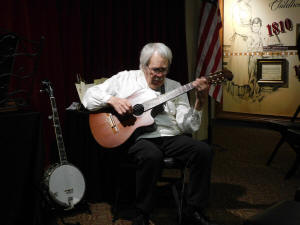
Being an expert in music, Barnard
incorporated music into the program by featuring some songs that had
meaning for slaves wishing to escape to the north and freedom.
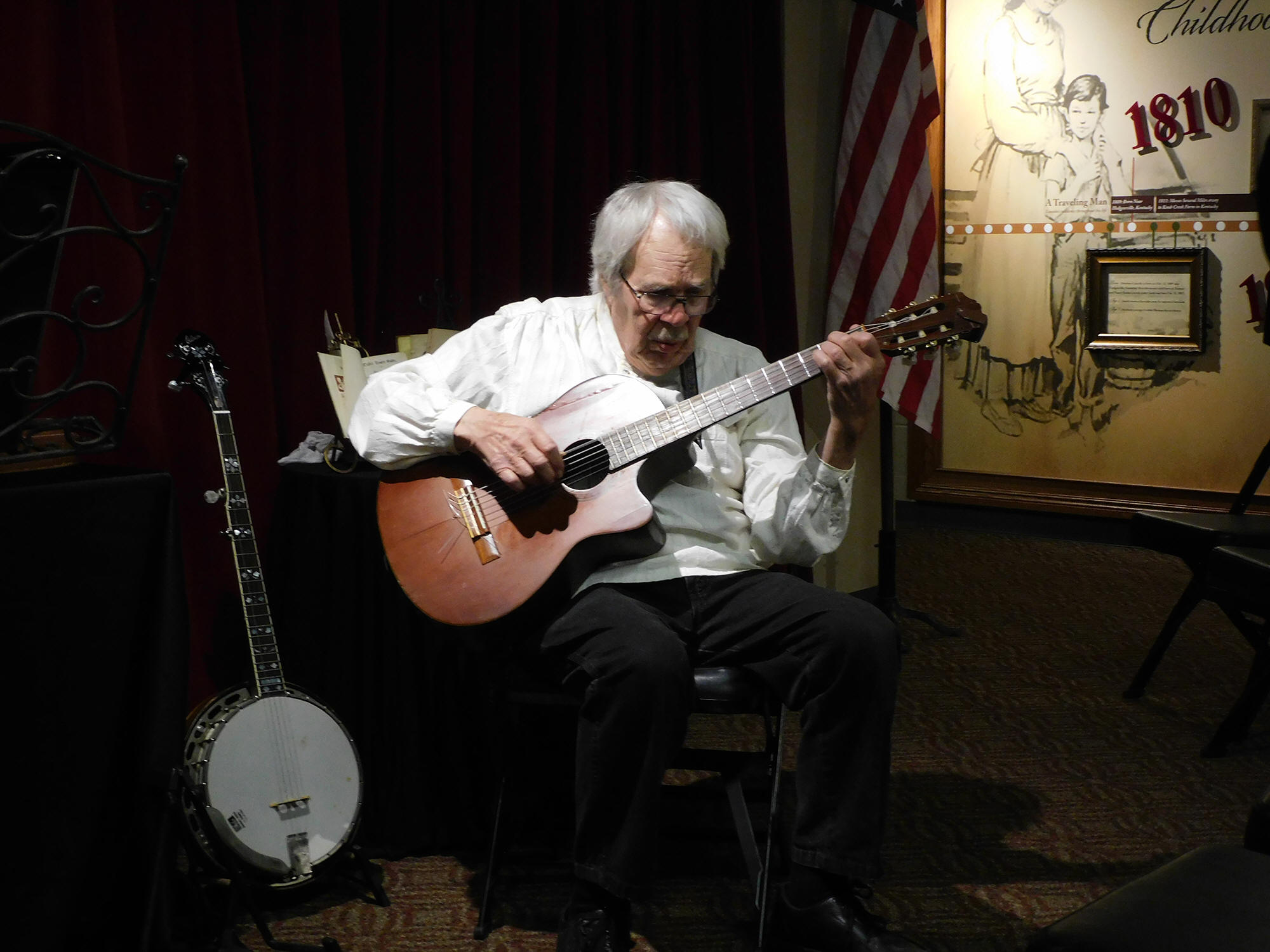
Barnard sang with her husband offering accompaniment on the guitar
and banjo.
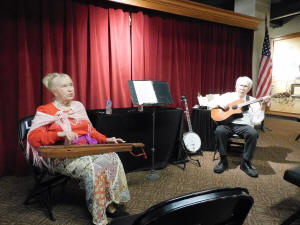
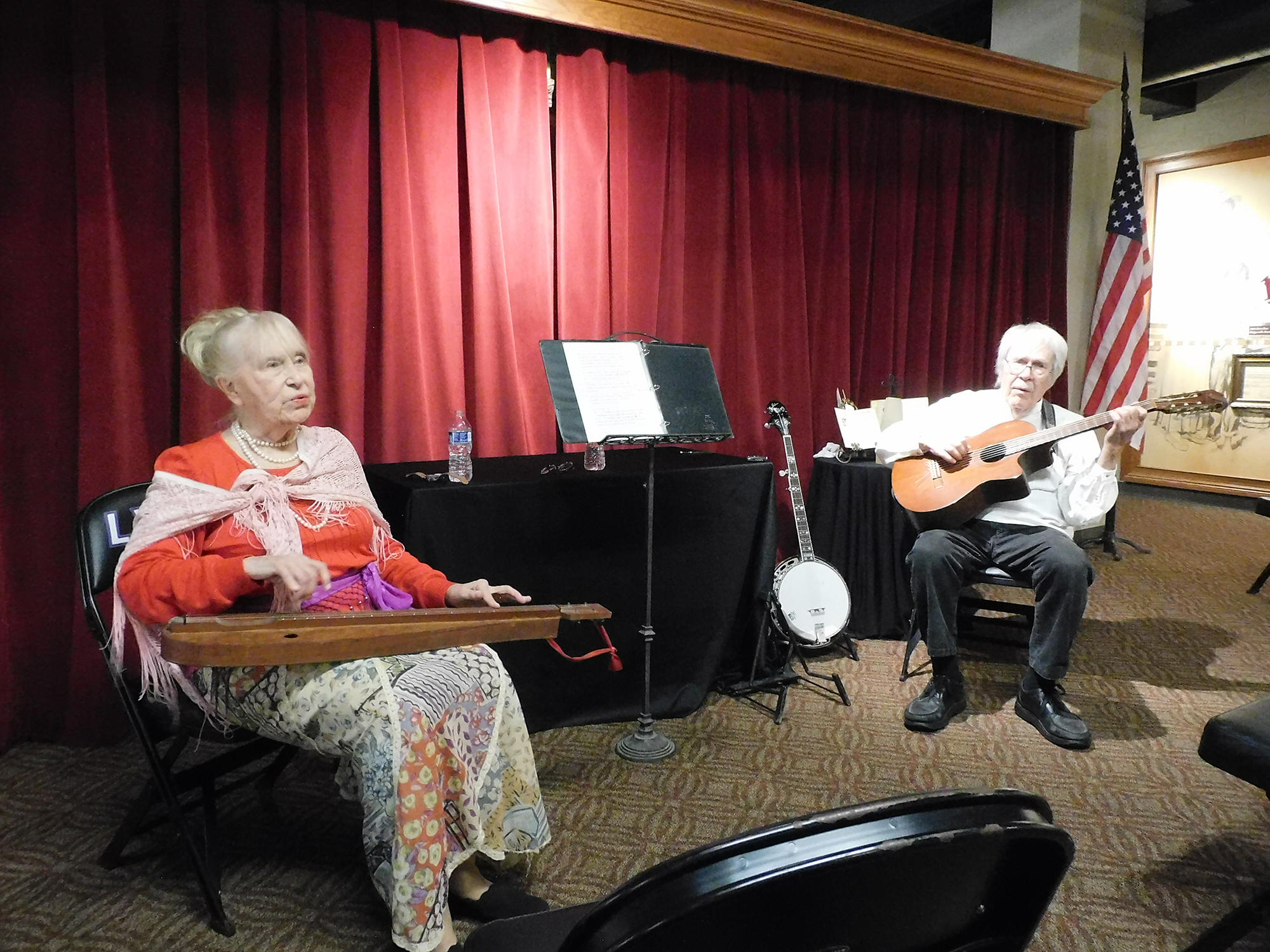
During one song, she joined in
playing the dulcimer with husband Wes on the guitar.
The first song was Follow the Drinking Gourd, which was a folk
slavery era song.
She began with the chorus and asked the guests to sing along with
her.
“Follow the drinkin' gourd.
Follow the drinkin' gourd,
For the old man is comin' just to carry you to freedom.
Follow the drinkin' gourd.”
The drinking gourd is the big dipper in the night sky, which points
to the north star. The message was to follow the north star, north.
Other verses spoke of following the river and there was a reference
to “Left foot, peg foot, traveling on,” talking about a peg leg
symbol carved on trees to show the way. This was a reference to
early abolitionist Peg-Leg Joe who originally taught the song to
slaves as simple directions for following the marks that had been
left for them. The symbol resembled a peg-leg with the tip of the
peg showing which direction to go.
Another song Barnard led was “Swing Low Sweet Chariot” saying that
the words had secret meanings for slaves. The chariot was the
underground railroad, the angels were the people who helped the
slaves to freedom, and the Jordan was the Mason-Dixon line.
“Amazing Grace” was the final song she sang, encouraging everyone to
sing along. It was written in 1779 by John Newton, after he was
converted and became a clergyman and abolitionist. Prior to that
time, Newton had been a sea captain and became involved in the slave
trade. He was converted in 1748 and in 1754 he ended his days on the
sea, began studying Christian Theology and later became an
abolitionist working to free the slaves of the south.
When Barnard was finished, she entertained questions from the
audience. She was asked about her wardrobe for her portrayal of
Stowe, because all published photos show Stowe in black. Barnard
said that indeed Stowe did wear a lot of black, because she suffered
a good many losses in her lifetime and spent much time in mourning.
On the other hand, Barnard said that Stowe was a colorful woman in
her personality and her beliefs, and it was that colorful side of
Harriet Beecher Stowe that Barnard wished to portray.
Barnard also talked about some of Stowes losses including her
toddler who died of cholera, and a grown son who had become an
alcoholic. Barnard said the Stowes purchased an orange plantation in
Florida after the war with the hopes of keeping their son there and
bringing him out of his alcoholism, but the son “escaped” and ran to
San Franscisco where he was not heard from again.
Barnard had lost several children, and had once said, “my sadness
helped me to feel deeply in my writing.”

LHM director Ron Keller asked how
Stowe was regarded because of her writing. Barnard said that her
family was very supportive, as were many others, but there were
times when people ridiculed and criticized.
At the end of the hour, Keller thanked the audience, thanked
Barnard, and encouraged everyone to examine the original edition of
Uncle Tom’s Cabin books on display at the museum.
[Nila Smith] |