|
At
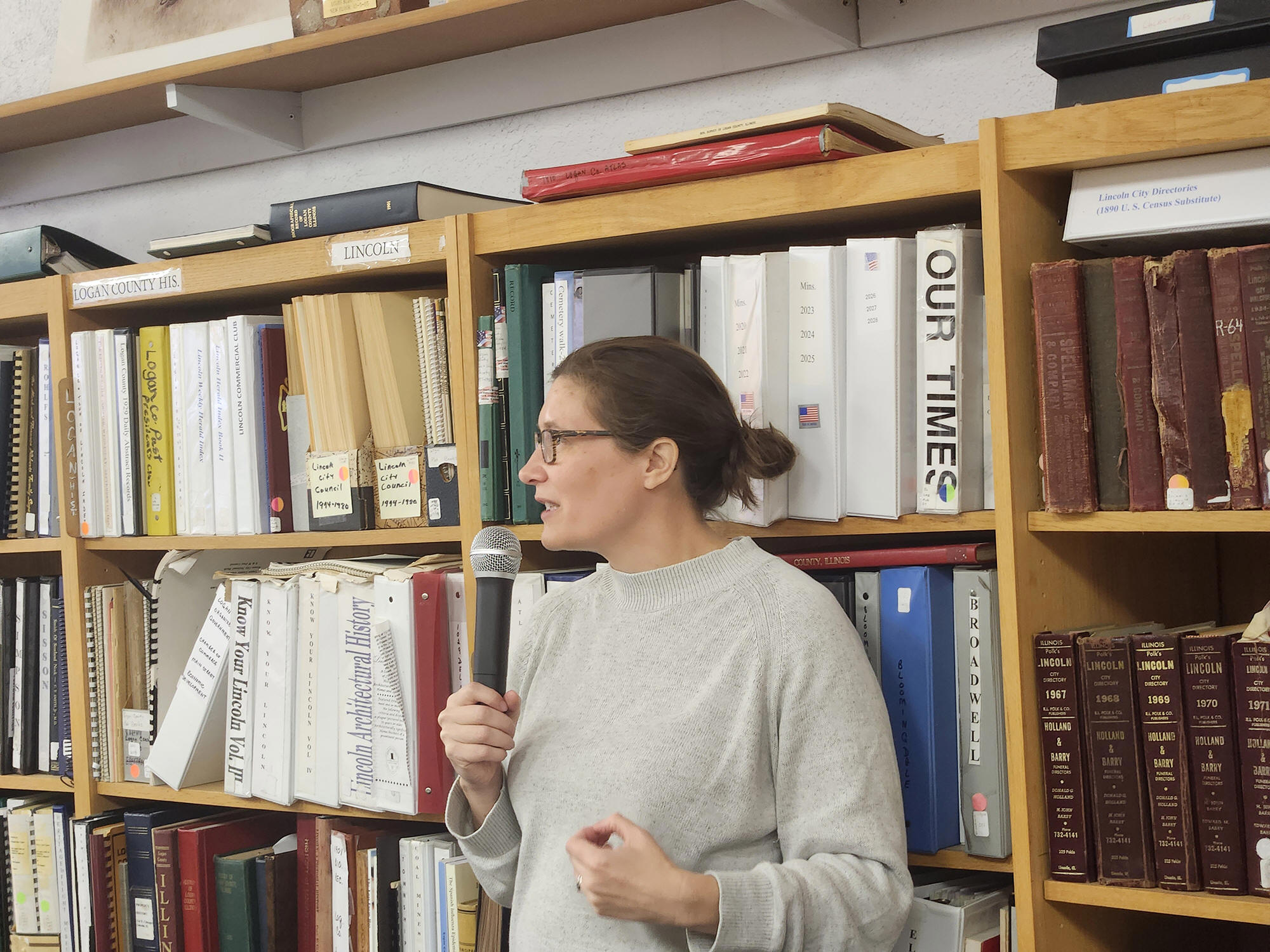
the October 2026 Logan County Genealogical and Historical Society
meeting, Erica Holst of the Illinois State Museum in Springfield
talked about the history of Route 66.
For a recent Route 66 project, Holst and a colleague interviewed 100
people who travelled along the route in its heyday. Since 2026 is
the 100th anniversary of Route 66, there has been a lot of interest
on the topic.
Holst said originally, Route 66 was the fastest, best and most
scenic way to travel the United States. This route began in the
early days of road travel. When automobiles first hit the scene,
they were being integrated into a society built around horses and
wagons.
The first couple of decades of the twentieth century were spent
catching up to the idea of people having cars. There were no traffic
signs, no driver’s licenses, no rules of the road and no speed
limits.
Before cars, roads were a patchwork of roads across farmers’
properties, town roads and county roads.
By the 1920s, Holst said the federal government decided to create a
national road system. In the first highway system, North and South
roads were assigned even numbers and East and West roads odd
numbers.
Route 66 broke that mold. Holst said businessmen and statesmen
decided to name the route 66 because the name had a ring to it. Soon
there was a Route 66 association and advertisements for the route.

The 1920s was the peak of the golden age of road travel. People
packed food and stayed in tents as they travelled the route. Most
leisure travel came to a halt in the 1930s due to the depression.
However, dust bowl farmers used Route 66 to head west to California
to find work. Author John Steinbeck dubbed Route 66 the mother road
in his 1939 novel The Grapes of Wrath, which describes those leaving
the dust bowl for a better life.
In the 1940s, with gasoline and tire rationing, there was still not
a lot of leisure travel. Life was geared towards military
mobilization. California had many training bases and factories.
Route 66 becomes an artery for travel geared toward the war effort.
By the 1950s, many families hit the open road. Holst said it was the
birth of the family road trip with people piling kids in the station
wagon to see America. Around the 1970s, interstate travel supplanted
Route 66 travel.
Starting in the 1990s and on into the 21st century, Holst said there
was a resurgence of Route 66 travel. Now around two million people
travel the route each year with many coming from overseas especially
in this centennial year.
Holst then told stories people shared about Route 66 in interviews.
For example, people remembered picnics in the car, mom and pop
businesses and drive ins.
As a black man travelling on Route 66 Steven R. remembers being
unsure of what businesses would welcome. His family packed shoebox
lunches filled with chicken, cheese and crackers, apple, pound cake
and red pop.
Automobiles travel transformed where people stayed. In the early
days, people pitched tents. some stayed in tourist houses with
homeowners renting out a room.
Since camping sometimes led to problems when people parked on
private property, communities created auto camps where people could
camp for a small fee. Cabin courts were barebones. Some farmers
rented out chicken coops, and those who stayed in them brought their
own sheets and blankets. Weatherized cabins were another option.
Big cities had hotels, but Holst said people travelling the route
started staying in motels right off the road. A man named David
remember driving the route and looking for vacancy signs. Sometimes
they would have to travel many miles to find a place with available
rooms.
[to top of second column] |

Finally, chain
hotels were established. Holiday Inn and other chains became
popular because many were right off the exit.
The Green Book listed where black travelers could get food or a
room. Holst said black families developed strategies like
travelling in caravans, travelling at night and wearing chauffer
caps then telling people they were taking the car to their
employer’s house. One black mom who shared her story with Holst
remembered driving in caravans for safety at night.
Kathryn H. recalls her family looking for places friendly to
black travelers and only later understood her parents were
protecting her from segregation.
A woman named Michelle remembers her family moving from New York
to California for her dad’s job.
Along Route 66, Holst said there were Burma shave signs with ads
and neon lights on businesses to draw people’s attention. The
route had museums and tourist traps. In front of businesses,
there were fiberglass giants with several designed to look like
lumberjacks. Today some of these giants are being restored.
Holst then talked about how travel has changed. For example,
seat belts used to be optional. Seat belt laws did not kick in
until the 1980s and even then, many did not use seatbelts.
Navigation is on our phones and in cars now, but for years,
people used paper maps to navigate.
When families travel today, kids often have devices but they
used to play games in the car. Now cars have air conditioning
and individual controls, but in earlier days, people drove with
the windows down.
Something Marsha H. remembers is a road trip in the 1950s where
her dad put a piece of plywood covered with quilts in the back
of the car for her to play on. Unfortunately, when her dad tried
to toss his cigarette out the window, it caught the quilts on
fire.
When Holst asked if anyone had any questions or stories, one
LCGHS member told her about Kristin Hannah’s book Four Winds,
which talks about travelling Route 66 to move west.
There was a question about how long it took to construct Route
66. Holst said much of it joined to existing roads that were
branded as Route 66.

One member recently met a man who had
ridden the train from Seattle to Chicago then travelled the route on
his bike. Another said a runner planned to travel Route 66 from
Chicago to Santa Monica, California in 100 days.
Another member remembers his mom buying a basket for holding
sandwiches on a Route 66 trip. He still has the basket.
As Holst said, talking to people on Route 66 is part of the
experience. At the Illinois State Museum, the Route 66 exhibition is
on display until next year.
Illinois State Museum’s Erica Holst photo slideshow
[Angela Reiners] |