Nigeria confirms Ebola case in Abuja as woman who arrived from Uganda
tests positive
[October 21, 2026]
By OPE ADETAYO
LAGOS, Nigeria (AP) — Nigeria confirmed an Ebola case in its capital,
Abuja, on Tuesday after a woman who arrived from Uganda tested positive
for the virus, the Health Ministry said.
The woman began showing symptoms on Oct. 7 and was admitted to a private
hospital in Abuja on Oct. 11, where she was later diagnosed with Ebola.
It is unclear when she arrived in Nigeria.
Health Minister Muhammad Pate said authorities had begun tracing 44
people identified as contacts of the patient. “We are doing everything
possible to contain this case by tracing all the contacts the individual
may have had,” he said.
Uganda had previously reported Ebola cases, but it later declared itself
free of the virus.
Uganda's Ministry of Health said the patient had only transited through
Uganda and that she is a Nigerian woman who had been on a business trip
to Congo's eastern region. The Nigerian authorities have not disclosed
her nationality.
“Travel through Uganda does not establish that infection occurred here.
The location of exposure remains under investigation,” the ministry said
in a statement. The ministry insisted Uganda has “no confirmed active
Ebola cases."

Nigeria is the latest country to report an Ebola case as the latest
outbreak spreads across the region. Kenya confirmed its first case
earlier this month and has since recorded nine infections.
Dr. Jean Kaseya, director general of the Africa Centers for Disease
Control, said on X that “we are facing an extremely serious threat,”
with a fatality rate of nearly 50% of cases.
“This Bundibugyo Ebola outbreak has already become the most
geographically extensive in history, affecting several countries spread
across three regions of Africa,” he said.
The Nigeria Centre for Disease Control said two weeks ago it was
stepping up surveillance following the detection of Ebola in Kenya and
strengthening the country’s preparedness for a potential outbreak.
[to top of second column]
|
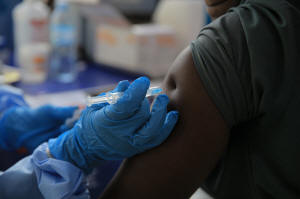
A health care worker administers a dose of Ervebo vaccine against
the Ebola virus in Beni, North Kivu province, eastern Congo, Friday,
Oct. 16, 2026. (AP Photo/Sebastien Kitsa Musayi)
 “These efforts have focused on early
detection, isolation and referral, laboratory diagnosis, infection
prevention and control, contact tracing, risk communication and
protection of health care workers,” the agency said.
Nigeria established an Ebola task force in June following the
outbreak in Congo in mid-May.
“We do not want a repeat of what happened during the last outbreak
when a carrier entered the country, and everyone was scrambling to
respond," Femi Gbajabiamila, chief of staff to President Bola Tinubu,
said when the task force was announced. “We have covered a lot of
ground and established structures to address any potential threat.”
The spread of Ebola beyond Congo has heightened longstanding fears
among health authorities about the rapid transmission of the rare
Bundibugyo virus, which has infected more than 9,500 people and
killed more than 4,600 people.
The latest outbreak is the fastest-spreading Ebola outbreak on
record and is on track to exceed the deadliest on record, West
Africa’s regional outbreak between 2014 and 2016, which killed
11,000 people, WHO has said. Nigeria was one of the countries
affected, recording 20 cases before the outbreak was declared over
in the country after three months.
All contents © copyright 2026 Associated Press. All rights reserved
 |