HHS unveils program to address homelessness and addiction, part of a set
of new initiatives
[February 03, 2026]
By ALI SWENSON
NEW YORK (AP) — Health Secretary Robert F. Kennedy Jr. on Monday
announced that his department will devote $100 million toward a pilot
program addressing homelessness and substance abuse in eight cities,
building on an executive order President Donald Trump signed last week
related to addiction.
The U.S. Department of Health and Human Services will also make
faith-based organizations eligible for addiction-related grants and
expand states’ ability to use federal health funding for substance abuse
treatment in certain situations involving children, Kennedy said at an
annual “Prevention Day” event for the Substance Abuse and Mental Health
Services Administration.
The new initiatives signal the administration acting on an issue that
hits close to home for many Americans – including Kennedy, who has been
open about his past heroin addiction and lifelong commitment to
recovery. They represent some quick momentum for Trump’s executive order
signed last Thursday launching what Trump calls the “Great American
Recovery Initiative” to better align federal resources on the addiction
crisis.
Yet the announcements come as the administration’s actions so far have
created uncertainty, fear and logistical challenges for mental health
and substance abuse treatment providers around the country.
Over the past year, about a third of SAMHSA's roughly 900 employees have
been laid off. The agency and the organizations it serves are still
reeling from the administration's whiplash-inducing reversal last month
that briefly eliminated then abruptly restored $2 billion in grant
funding for substance abuse and mental health programs. Advocates and
providers have said they don't feel they can plan for the future because
the administration has created an environment of uncertainty.

HHS spokesperson Andrew Nixon said the department is “focused on reform
and ensuring that federal resources are used effectively, responsibly,
and in ways that deliver real results for those struggling and their
families.”
“As part of the Great American Recovery announced just last week, HHS is
moving forward with new funding, expanded flexibilities, and targeted
actions that strengthen the mental health and substance use treatment
system and provide greater support for providers on the ground,” he
said.
Federal data shows that overdose deaths fell through most of last year,
suggesting a lasting improvement in an epidemic that had been worsening
for decades. Still, that decline was slowing, the figures showed.
[to top of second column]
|
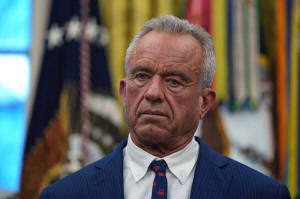
Health and Human Services Secretary Robert F. Kennedy Jr. listens as
President Donald Trump speaks at an event on addiction recovery in
the Oval Office of the White House, Thursday, Jan. 29, 2026, in
Washington. (AP Photo/Allison Robbert)
 Kennedy said SAMHSA's new pilot
program will be called STREETS, or Safety Through Recovery,
Engagement and Evidence-Based Treatment and Supports. He said the
program, first directed at eight unspecified communities, will build
integrated care systems for people experiencing homelessness,
substance abuse and mental health challenges and help them find
housing and employment.
While that's an idea many advocates support, “the devil's in the
details,” said Regina LaBelle, director of the Center on Addiction
and Public Policy at Georgetown Law’s O’Neill Institute.
LaBelle said the real-world impact of the funding depends on which
cities receive it and how the program is implemented. She also
raised questions about how the program was paid for, and whether it
will take away from others that already have successfully lowered
overdose death rates.
Later Monday, Kennedy appeared at another event focused on substance
abuse and mental health – the launch of a bipartisan initiative
called Action for Progress by his cousin, former Democratic Rep.
Patrick Kennedy, now a partner at the national health consultancy
Healthsperien.
The two scions of one of the nation’s most prominent political
families fell on different sides of the 2024 presidential race but
have found common ground on the issue that is personal for both of
them, said Patrick Kennedy, who has shared publicly about his
bipolar disorder and battle with alcoholism and drug addiction.
“When we go into recovery rooms we don’t think of ourselves as
Democrats and Republicans,” the former Rhode Island congressman said
in a phone interview Monday. “I've grown up with my cousin, I know
him, and I have an opportunity to share with him all that I've
learned over the years in policymaking on mental health and
addiction — and he's welcomed it.”
All contents © copyright 2026 Associated Press. All rights reserved
 |