Ex-FBI officials charged in the case about Hunter Biden's laptop are due
back in court
[October 27, 2026]
By ERIC TUCKER and ALANNA DURKIN RICHER
WASHINGTON (AP) — Two former FBI officials charged with lying to
Congress about their participation in investigations involving Hunter
Biden, the son of former President Joe Biden, are due back in court
Tuesday in a case their lawyers have described as baseless and
politically motivated.
The prosecution of Nikki Floris and Bradley Benavides, announced Friday,
is the latest in a series of splashy and politically charged
investigative actions the Justice Department has undertaken in the
run-up to next week’s midterm elections.
The case accuses the former officials of falsely playing down their
knowledge about a laptop the Justice Department says Hunter Biden
abandoned at a computer repair shop in 2019. But beyond that, it
represents a Trump administration broadside against a since-disbanded
FBI task force that was set up to monitor foreign influence.
Congressional Republicans have long criticized the task force, saying it
tried to discredit their own investigations into the Biden family.
Defense lawyers are expected to challenge the case at a preliminary
hearing Tuesday in Washington's federal court, including by highlighting
the unusual fact that the ex-FBI officials were charged via a criminal
complaint signed by a magistrate judge rather than an indictment voted
on by a grand jury. The Justice Department is thought to have repeatedly
struggled in high-profile cases to persuade grand juries in the nation’s
capital to return indictments.

It is a very intricate saga
The prosecution, a rare Justice Department criminal case against a
former employee, revisits a tangled saga that roiled the final weeks of
the 2020 race after the New York Post revealed the existence of a laptop
it said had been dropped off by the younger Biden at a Delaware computer
repair shop about a year earlier.
The Post said it had obtained a hard drive of the laptop from Rudy
Giuliani, a close ally of President Donald Trump, and reported on some
of the contents of the computer, including emails that appeared to show
some of Hunter Biden's foreign business dealings.
The curious circumstances of the laptop’s discovery raised concerns
among Democrats and former intelligence officials about the possibility
of Russian involvement, particularly when the Trump administration’s own
intelligence community had assessed that Moscow was attempting to
undermine the candidacy of Democratic nominee Joe Biden, who went on to
defeat Trump in 2020, and as Giuliani had traveled abroad looking for
dirt on the Bidens.
[to top of second column]
|
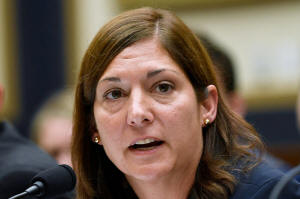
Deputy Assistant Director for Counterterrorism at the FBI Nikki
Floris, testifies before the House Judiciary Committee hearing on
Capitol Hill in Washington, Oct. 22, 2019. (AP Photo/Susan Walsh,
File)

But Trump's then-national intelligence director, John Ratcliffe,
quickly sought to quell speculation about the laptop's provenance by
saying there were no signs it had anything to do with Russian
actors. The FBI said it had nothing to add to Ratcliffe's statement
and investigated the younger Biden on gun and tax charges that later
resulted in felony convictions. President Joe Biden pardoned his son
in late 2024.
The accused led the Foreign Influence Task Force
The FBI officials under scrutiny, Floris and Benavides, were leaders
of the Foreign Influence Task Force, which was established in the
first Trump administration to police influence campaigns staged by
Russia and other nations aimed at sowing discord, undermining
democracy and spreading disinformation.
In that capacity, the FBI officials briefed Republican Sens. Chuck
Grassley and Ron Johnson in August 2020 as the lawmakers were doing
their own investigation into Hunter Biden’s work in Ukraine. News of
the briefing leaked, and the senators lashed out at the FBI, saying
their efforts to scrutinize the Biden family had been discredited
and falsely linked to Russian disinformation.
The criminal complaint accuses them of lying to lawmakers in 2023 by
denying contemporaneous knowledge of the Biden laptop or
participating in internal FBI conversations about it. Their lawyers
have denied any allegations of wrongdoing.
The task force was disbanded in February 2025 by then-Attorney
General Pam Bondi.
All contents © copyright 2026 Associated Press. All rights reserved
 |