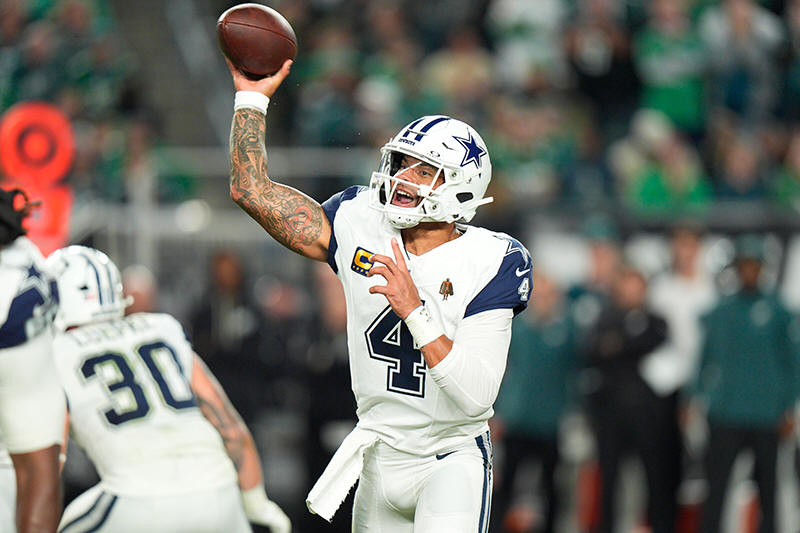
Dak Prescott throws 3 TD passes,
Javonte Williams runs for 155 yards as Cowboys beat Eagles 38-21
[October 27, 2026]
By DAN GELSTON
PHILADELPHIA (AP) — Tanner McKee and the Philadelphia Eagles still
had a potential victory within their grasp in the fourth quarter
when the career backup threw a pass into the outstretched hands of
DeMarvion Overshown.
The Cowboys linebacker raised the ball in celebration after making
the clutch play the Eagles’ defense could not deliver.
Look at Dallas now, playing for a division title that's up for
grabs.
Dak Prescott threw for 212 yards and three touchdowns, two to CeeDee
Lamb, and the Cowboys handed the Eagles their fifth straight loss,
38-21 on Monday night.
The Eagles (2-5) are spiraling into a disaster of a season with
their longest skid since 2016.
Javonte Williams ran for a career-high 155 yards and a touchdown for
the Cowboys (3-4), who still have realistic designs on an NFC East
title. The New York Giants lead the division at 4-2-1, and the
Cowboys are the only team with two division victories.
“Come out, get a division win on the road in a hostile environment
right before we get to go home for a couple of weeks, I think it was
massive,” Prescott said.
Philadelphia lost eight straight games in 2012 and had a seven-game
skid in 1994.
Eagles quarterback Jalen Hurts is expected to miss the rest of the
season because of blood clots in his lungs. McKee provided little
encouragement that he can turn the season around, completing 23 of
35 passes for 211 yards with one touchdown and one interception.

Prescott finished long drives with scores that McKee was unable to
match. The Eagles are 3-6 without Hurts since he became the starter
in 2021.
With Dallas trailing 21-20 late in the third quarter, Lamb hauled in
his second TD on a beautiful 16-yard floater from Prescott in the
corner of the end zone. Prescott ran in the 2-point conversion for a
28-21 lead.
Brandon Aubrey kicked field goals of 55, 27 and 24 yards. The final
kick extended Dallas’ lead to 31-21. Williams capped the scoring and
the first 150-yard rushing game by a Dallas player since Ezekiel
Elliott in 2018 with a 2-yard TD. The Cowboys finished with 204
yards rushing.
“Javonte, man, the power, the acceleration, it was there tonight. He
looked great,” Cowboys coach Brian Schottenheimer said.
Overshown sealed the win with the pick in his first game since he
suffered a hamstring injury in Week 1.
“Our division, we're in it,” Overshown said.
Unlike the Eagles.
McKee orchestrated the first Eagles touchdown drive in the third
quarter this season when they ran almost 10 minutes off the clock
and he hit rookie Makai Lemon for a 4-yard touchdown and a 21-20
lead.
The Eagles didn't score again and are running out of chances to
salvage their season.
“Football is going to deal you some tough hands at times,” coach
Nick Sirianni said. “Can you get up and keep fighting?”
[to top of second column] |
Dallas Cowboys quarterback Dak Prescott (4) throws during the second
half of an NFL football game against the Philadelphia Eagles in
Philadelphia, Monday, Oct. 26, 2026. (AP Photo/Chris Szagola)

High-scoring game early
The Cowboys got a field goal on their opening drive, and the
Eagles came right back and made it 7-3 on Saquon Barkley’s 8-yard
touchdown run. Barkley returned after missing the last two-plus
games with a hamstring injury and had 37 yards rushing on the drive.
Barkley entered with 36 yards rushing all season. He still seemed
bothered by the hamstring and had to visit the sideline medical
tent. Barkley also missed long stretches getting treatment for his
back on the sideline and finished with 62 yards on seven carries.
The Eagles also played without wideout DeVonta Smith.
Prescott threw touchdown passes of 9 yards to Lamb and 21 yards to
George Pickens that helped the Cowboys stretch their lead to 20-14
at halftime. Pickens’ catch was particularly impressive, as he
escaped tight coverage by safety Andrew Mukuba in the back of the
end zone and dragged his left foot sideways for the score.
“Stuck to the run. Had great balance,” Prescott said. “When you’re
able to do that, we should put ourselves in position like this. It
was a great environment. We knew we had to win. We came out and got
it done.”
Eagles' defense offers little resistance
The Eagles allowed 416 total yards with an average of 6.4 yards per
play and 25 first downs. Philadelphia has allowed at least 375 yards
in each game of its losing streak.
Lurie is an Eagles Hall of Famer
Eagles owner Jeffrey Lurie was inducted into the team's Hall of
Fame.
Lurie bought the Eagles on May 6, 1994, and since the turn of the
century they have been one of the top franchises in football. The
Eagles are one of three teams to play in four Super Bowls since 2004
and have won the only two titles in franchise history under Lurie's
ownership.
Lurie was flanked by Eagles Hall of Famers including Brian Dawkins
and Donovan McNabb and gave a brief halftime speech. However, unlike
other Hall of Fame inductees, Lurie did not hold a pregame news
conference. Sirianni remained the only team representative
addressing Hurts’ condition since he was injured.

Injuries
Eagles: Kick returner Britain Covey suffered a knee injury in the
first quarter.
Up next
Cowboys: Host Arizona on Sunday.
Eagles: At Washington in a Sunday night matchup of struggling NFC
East rivals.
All contents © copyright 2026 Associated Press. All rights reserved |