|
Atlanta holds annual Memorial Day
service
[May 27, 2026]
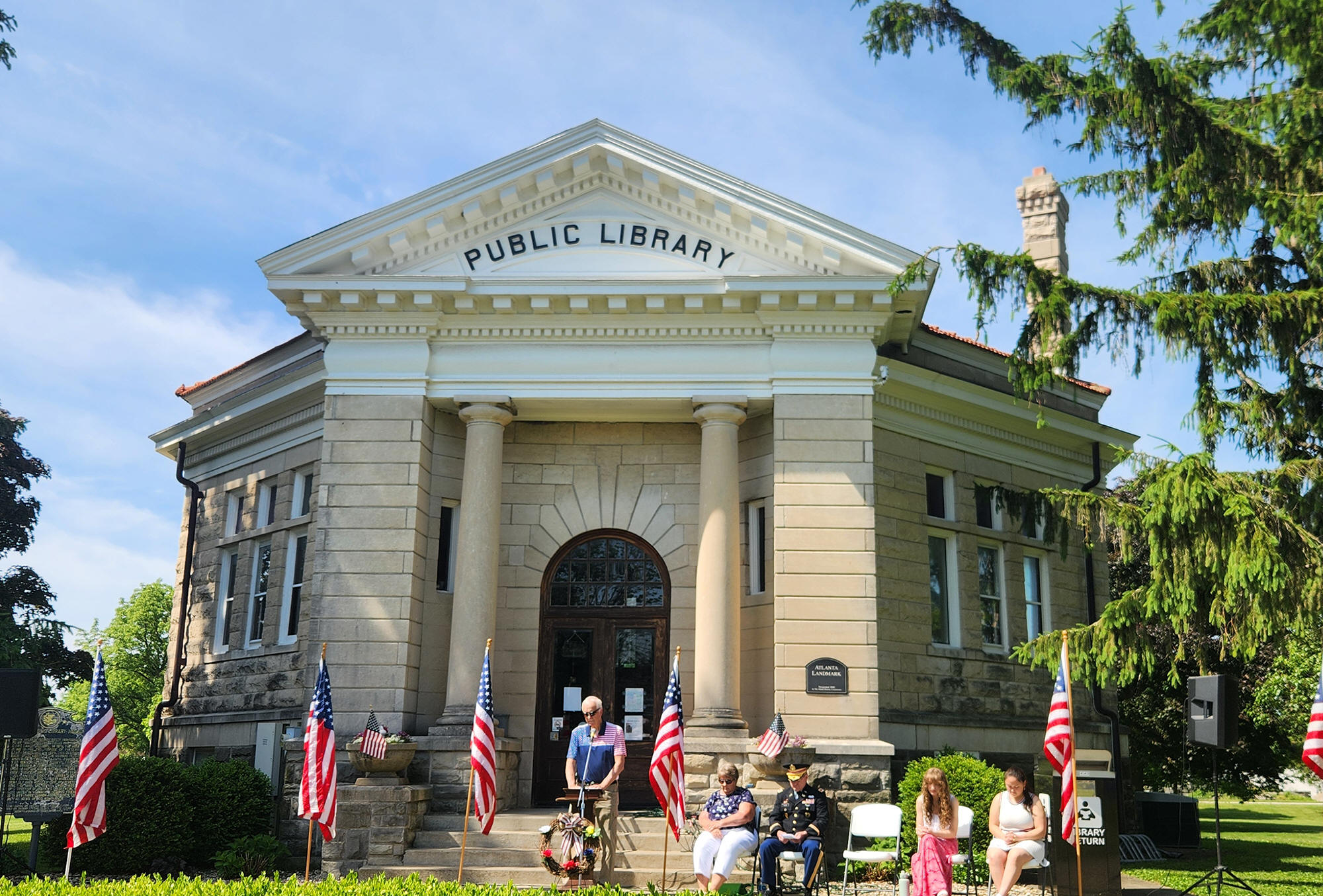
Atlanta held its annual
Memorial Day service on the library lawn Monday, May 25,
with retired Colonel Jim Allen as the keynote speaker.
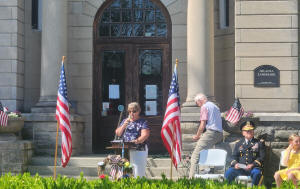
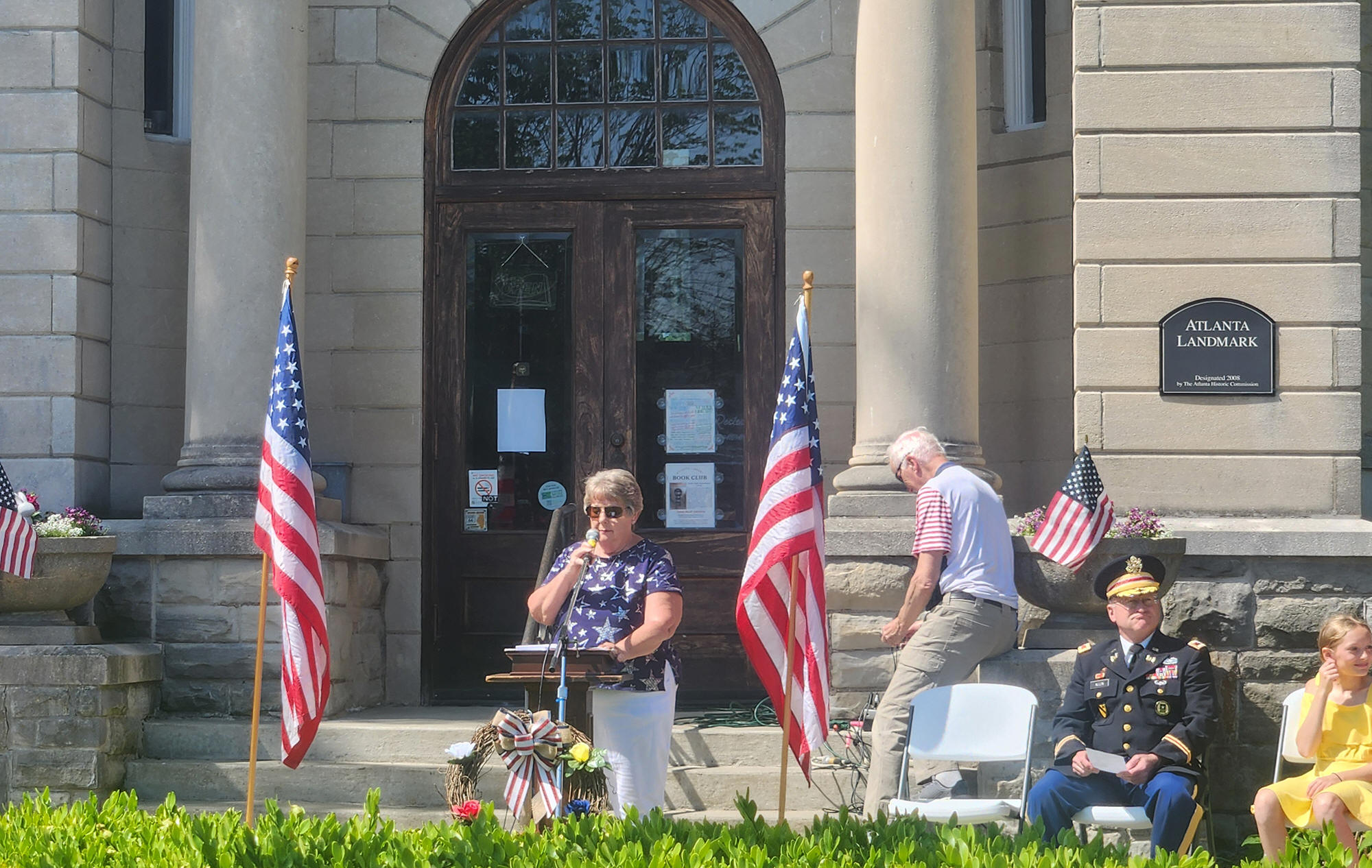
The service began with a welcome by
Connie Wertheim, who thanked the Atlanta Public Library, Larry
Collins, Memorial Day Committee members Helen Daugherty, Nancy
Miller, Linda Brookes and Nathan Soice. She also thanked Ed and
Angie Harrison and other volunteers who placed flags around
downtown.
Autumn Emberton and the Atlanta Ag 4H club then led the Pledge of
Allegiance.
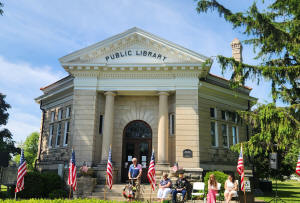
Larry Collins gave the opening
prayer thanking God for many who gave their lives for our freedoms.
He said we won our independence through the sacrifice of thousands
of brave human beings in wars over the years.
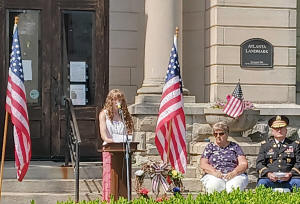
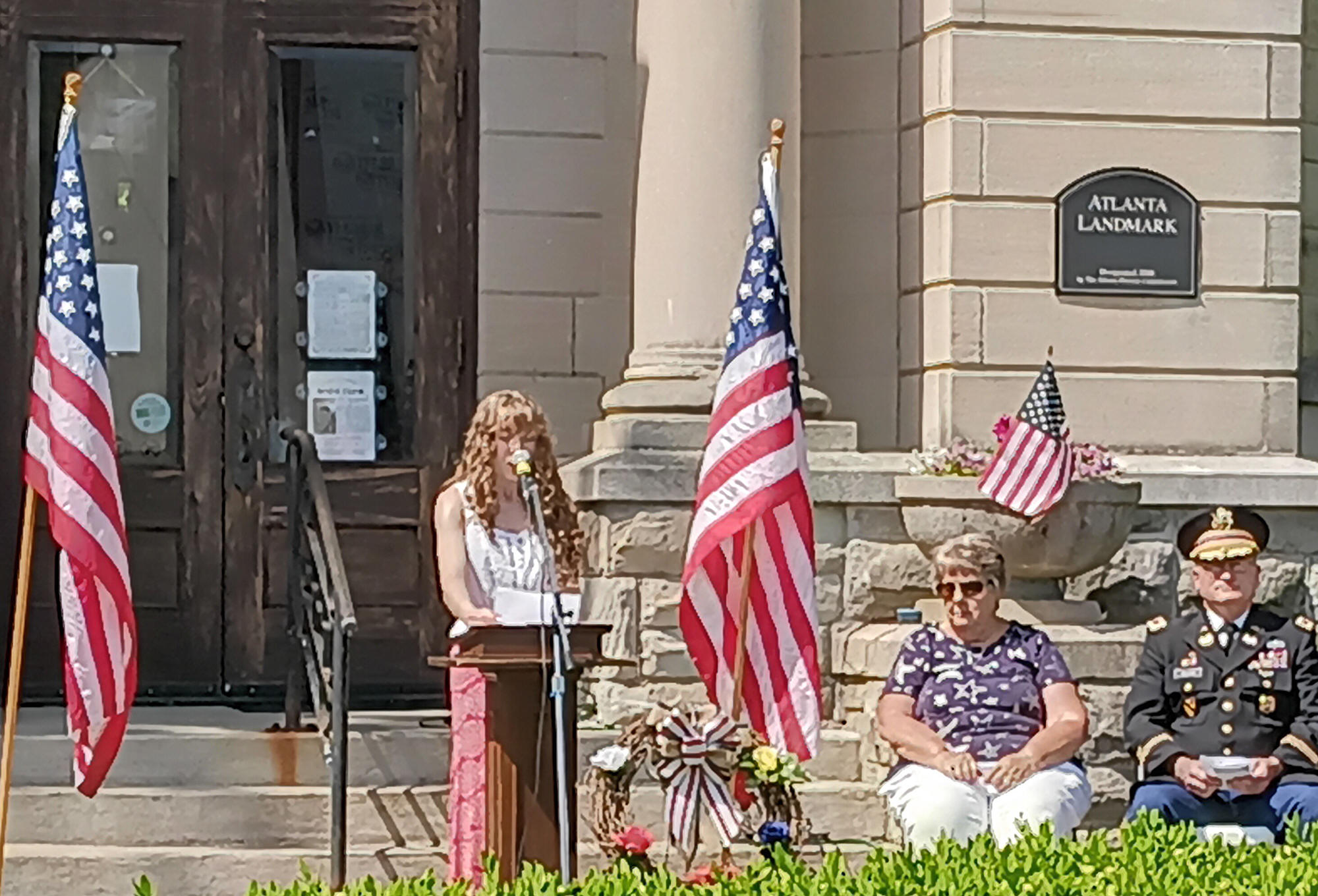
Next, Evie Emberton read Abraham
Lincoln’s Gettysburg Address which echoes the sentiments of fallen
soldiers and is often shared on Memorial Day.
Wertheim then read a tribute to those who fought for our freedoms.
In her tribute, Wertheim explained how the wreath in front of the
podium represents various wars. For the Revolutionary War and War of
1812, there are red streamers with a white stripe. A yellow rose
symbolizes the Civil
War, a white rose stands for the Spanish American War, and poppies
represent World War I and II. For the Korean War, there is a blue
rose, for the Vietnam War, a red rose and for Operation Desert
Storm, a semicircle of poppies. Other flowers represent the
Afghanistan and Iraqi Wars.
Before the keynote address, Diane Bicknell read the poem “Freedom
Isn’t Free” by Kelly Strong. The poem reflects on the sacrifices
many have made for our freedom and the families whose lives have
been affected by these sacrifices.
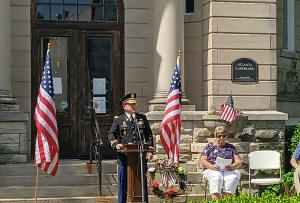
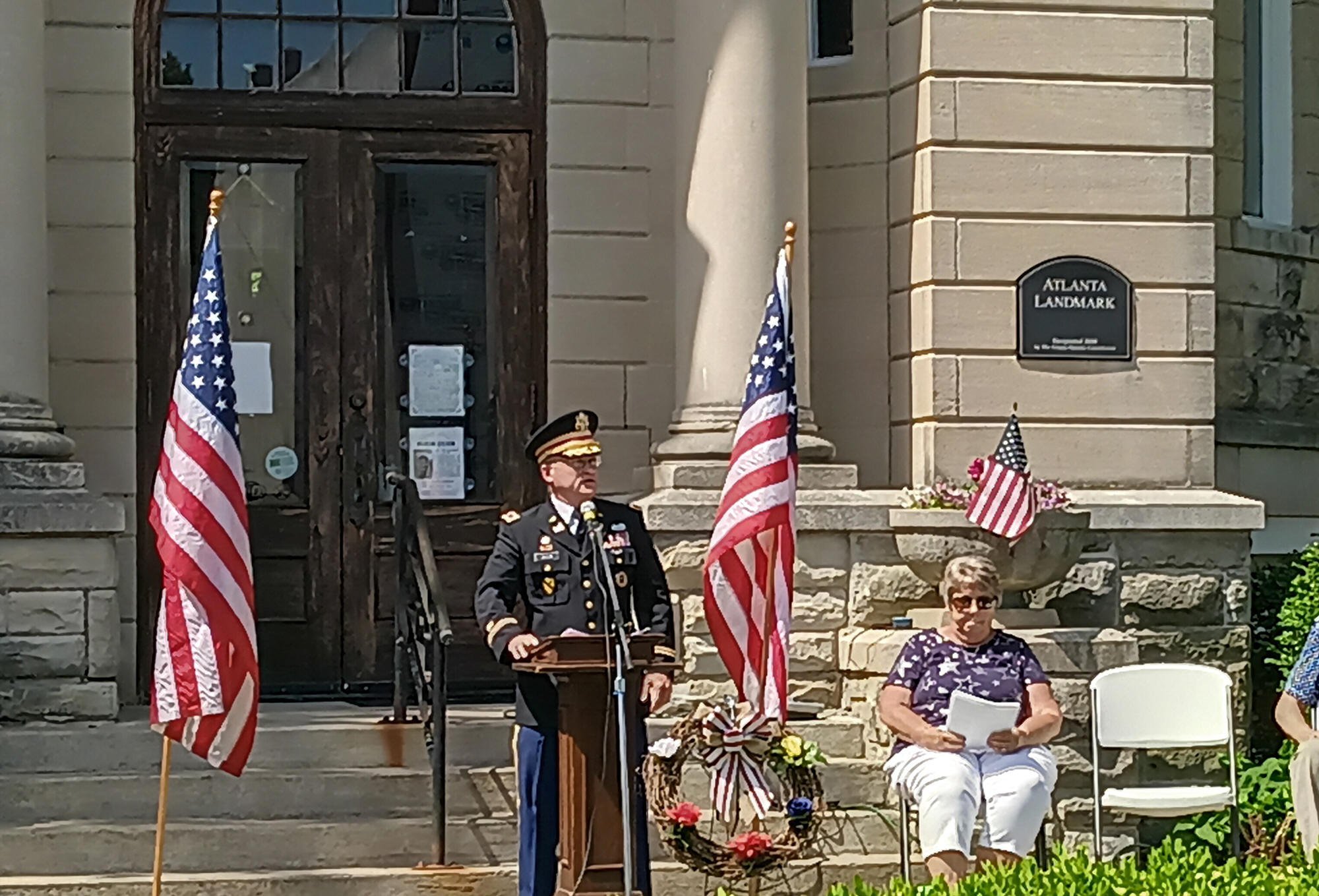
Wertheim then introduced retired
United States Army Colonel Jim Allen, who served in the Army, Army
Reserves and National Guard for 32 years and was deployed several
times. He has also been awarded numerous military awards and was a
faculty instructor for the Army War College. He is a licensed
professional Engineer in the State of Illinois and a member of
American Legion Post 263.
As Technical Director for Operational Science and Engineering of the
U.S. Army Engineer Research and Development Center’s Construction
Engineering Research Laboratory in Champaign, part of what Allen is
responsible is for technical leadership on a program in combat
engineering leading an interdisciplinary team of approximately 150
state and federal contracted staff.

As Allen began his address, he commended the small town for its
patriotism, saying it was really great to see the flags, the
volunteers and such a meaningful event.
On Memorial Day, Allen said he as a habit of going to the
Congressional Medal of Honor website and looking at the most recent
recipient of it. In March 2026 at the White House, Staff Sargeant
Michael Ollis was awarded the Congressional Medal of Honor
posthumously.
In August 2013, Ollis was an infantryman in the Tenth Mountain
Division in Afghanistan when the base was attacked. When Ollis heard
an explosion, he directed his men into bunkers then ran towards the
explosion. A large concrete truck exploded, creating a breech in the
wall and a complex attack occurred with gunfire, mortars, artillery
and grenades. Allen said insurgents penetrated through wire onto the
airfield and into buildings.
Ollis took extreme actions of leadership directing fire and driving
back forces. When an insurgent came around the corner, Ollis stepped
in front of Polish Army Lieutenant Karol Cierpica. Allen said Ollis
shot the insurgent, but the insurgent pulled the cord on his suicide
vest. It exploded and Ollis took the blast. In doing so, Ollis
spared the Polish officer’s life and helped counter the attack to
secure the base. Ollis died but protected the life of his friend.
The Polish officer was there for the Congressional Medal of Honor
ceremony and said Ollis was the first American to receive the
highest Polish award for an act of bravery in service.
Allen said his talk had three points: we remember the past, we
remember in the present and we remember for the future. Our memory
connects us from the past to the present to the future and is a
teacher.
Remembering is important and Allen said we gather here to remember
the deliberative act grounded in the past but very important to our
decisions of today and the way it shapes our future.
[to top of second column]
|

On today’s battlefield, Allen
said new threats and challenges are faced by service members
around the world. Unmanned drones in the air are now
commonplace. Though when Allen was deployed just ten years ago,
they were not a threat. There are robots on the ground and
unmanned systems in and under the water which create new threats
and challenges. Our enemies now possess space based or
artificial intelligence enabled reconnaissance and targeting
capabilities.
Remembering those who faced unprecedented challenges of the past
is something Allen said emboldens us as we face these challenges
and uncertainties.
On this Memorial Day we remember soldiers, sailors, airmen,
marines, coast guardsmen and merchant mariners who died in
service in acts both great and small. We remember those like
Sergeant Ollis who distinguish themselves by acts of gallantry
and bravery above and beyond the call of duty
Allen said we also remember those who died simply by their
willingness to serve, who were faithful to the call or
volunteered to serve but whom fate put in a time and place
requiring the ultimate sacrifice.

This year is quite a milestone for
our nation as we celebrate its 250th birthday. Allen said there have
been two and a half centuries of sacrifice by those who placed
others above themselves. It is an important thing to remember along
with the hard-won freedom and liberty for us to cherish now and each
day into the future.
In Allen’s admonishment of past, present and future, he asked
everyone to remember Continental Army soldiers who froze at Valley
Forge in the winter of 1776 during the Revolutionary War. They
stiffened our resilience to lead our family and community through
tough times.
Allen then asked everyone to remember and learn from the following
groups and what they faced during war:
Artillerymen during the War of 1812 Battle of New Orleans when it
was hot, and men struggled to maneuver through the miserable swamp
of Louisiana. Ultimately, they overcame the British, so Allen said
we should be dauntless in pursuit of our own goals.
Bayonet charges by Union forces during the Civil War Battle of
Little Round Top. The war abolished the institution of slavery, and
Allen said we should thereby be fearless in standing up for right
causes.
Mounted cavalry during the Spanish American War who charged up the
hill in the Battle of San Juan. Allen said thereby be bold to take
on new situations that may seem unformidable.
Service members who died choking on poison gas in World War I in
Europe. Allen said, resolve to make the most of every breath and
every moment you are blessed with.
Submariners who died in the deep oceans of the South Pacific or
North Atlantic during World War II. Allen said resolve to never
leave a word of appreciation or love unspoken to those you care
about.
Airmen shot down over the mountains of Korea or jungles of Vietnam
in the 50s and 60s. Allen said build your courage to overcome daily
attacks against self-esteem or mental health.
Marines and special operators who died during the global war on
terrorism. Allen said to become the strong confident leader your
family or friend may need in difficult times.
Service members who died from wounds or sickness suffered in combat
months or even years later. In remembering them, Allen said to
increase your own patience and stamina to model to the next
generation that humble enduring service is greater than
self-centered narcissism which can threaten the country’s values.
Remember the tomb of the unknown soldier and its inscription reading
“here rests in honored glory an American soldier, known but to God”
and continue to work diligently in your own tasks that benefit
others and daily do right even when praise or reward is not evident.
In closing, Allen said remembering is active not passive, so today
we gather and choose to remember. Remembering connects us to our
higher calling to faith, family, God and country. Today we remember
the fallen and the sacrifice of themselves and their families.
Thereby we strengthen our resolve to serve and sacrifice for the
greater good in our own lives for the future.
The keynote address was followed by Azul Kong singing the National
Anthem.
Wertheim then asked veterans who had fought in various wars to rise
and be recognized.
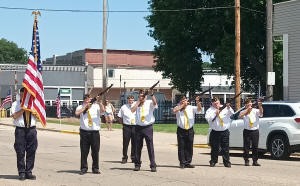
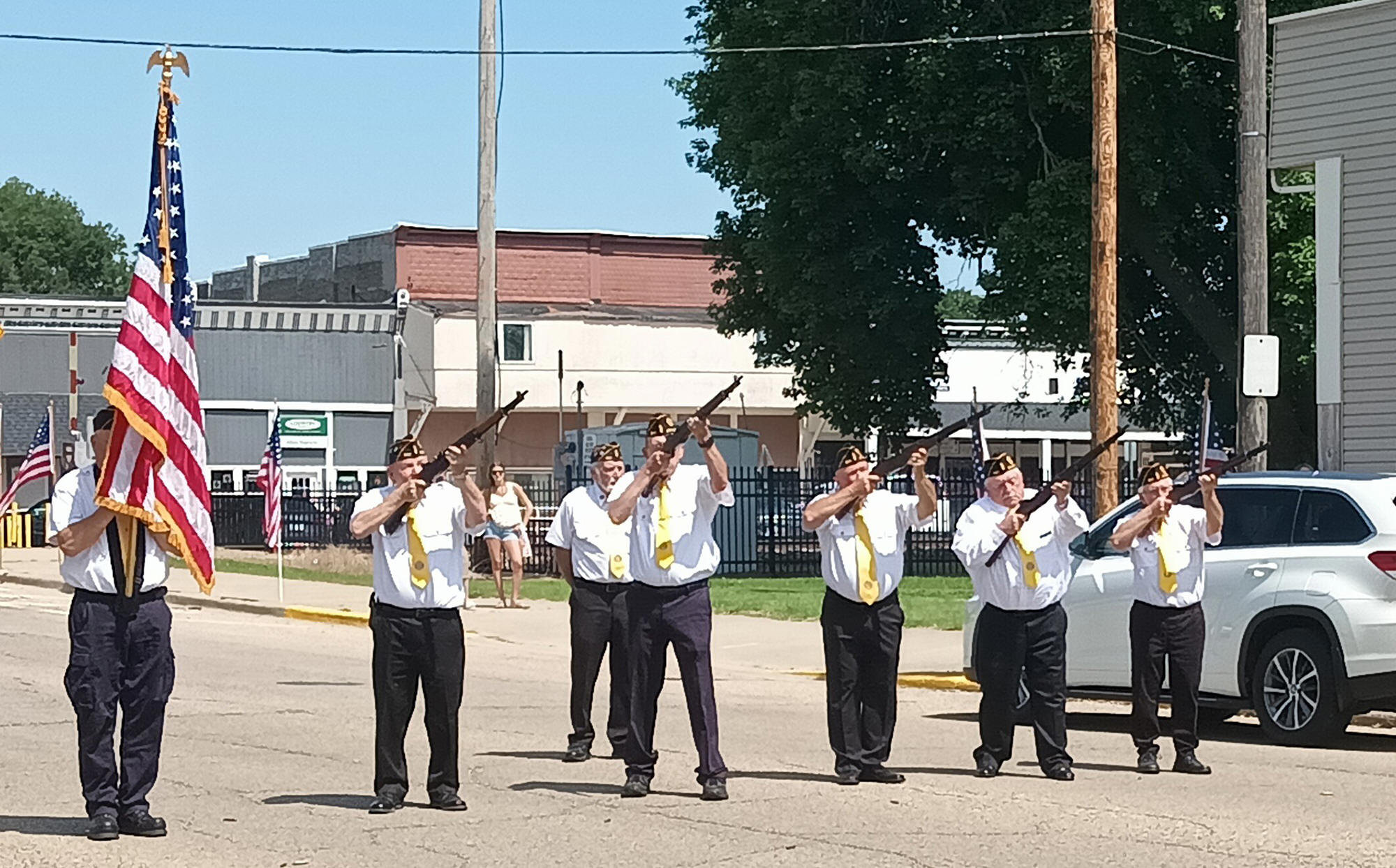
After Larry Collin’s closing
prayer, American Legion Post 341 did an honor guard salute and Taps
was played. The service ended with Tom Parks raising the flag.
Atlanta Memorial Day Service photo slideshow
Atlanta, IL Memorial Day
Service: Poety reading, Jim Allen gives keynote address and Anthem
video
[Angela Reiners]
|