|
Logan County Board
Zoning Committee Votes to Send 90-Day Data Center Moratorium on to
Full Board
[May 14, 2026]
On Wednesday, May 13th, the
Zoning and Economic Development Committee of the larger Logan County
Board held a special committee meeting over a possible extension of
the previous 60-day data center moratorium the board previously
passed. The meeting started just after 6:00 p.m. and was held at the
Oasis Senior Center in Lincoln.
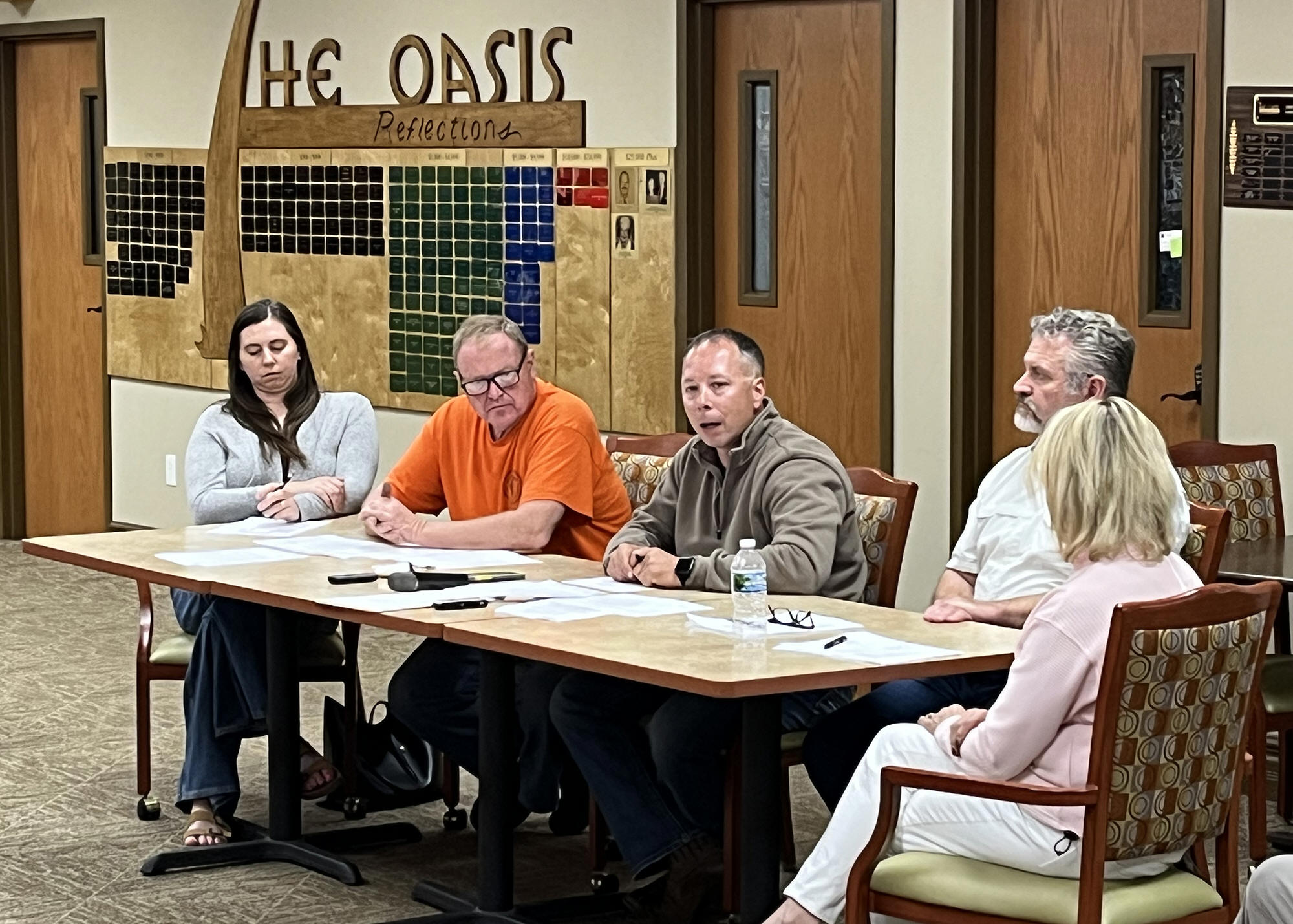
All five of the committee members were present, with Hannah
Fitzpatrick coming about half an hour late. In attendance were
Committee Chairman Dale Nelson, Committee Vice Chairman Kathy
Schmidt, Joseph Kuhlman, Bob Sanders, and Fitzpatrick.
The two items under new business on
the agenda were a presentation by Hut 8 and a vote on the
moratorium. Nelson handed the floor over to the Hut 8
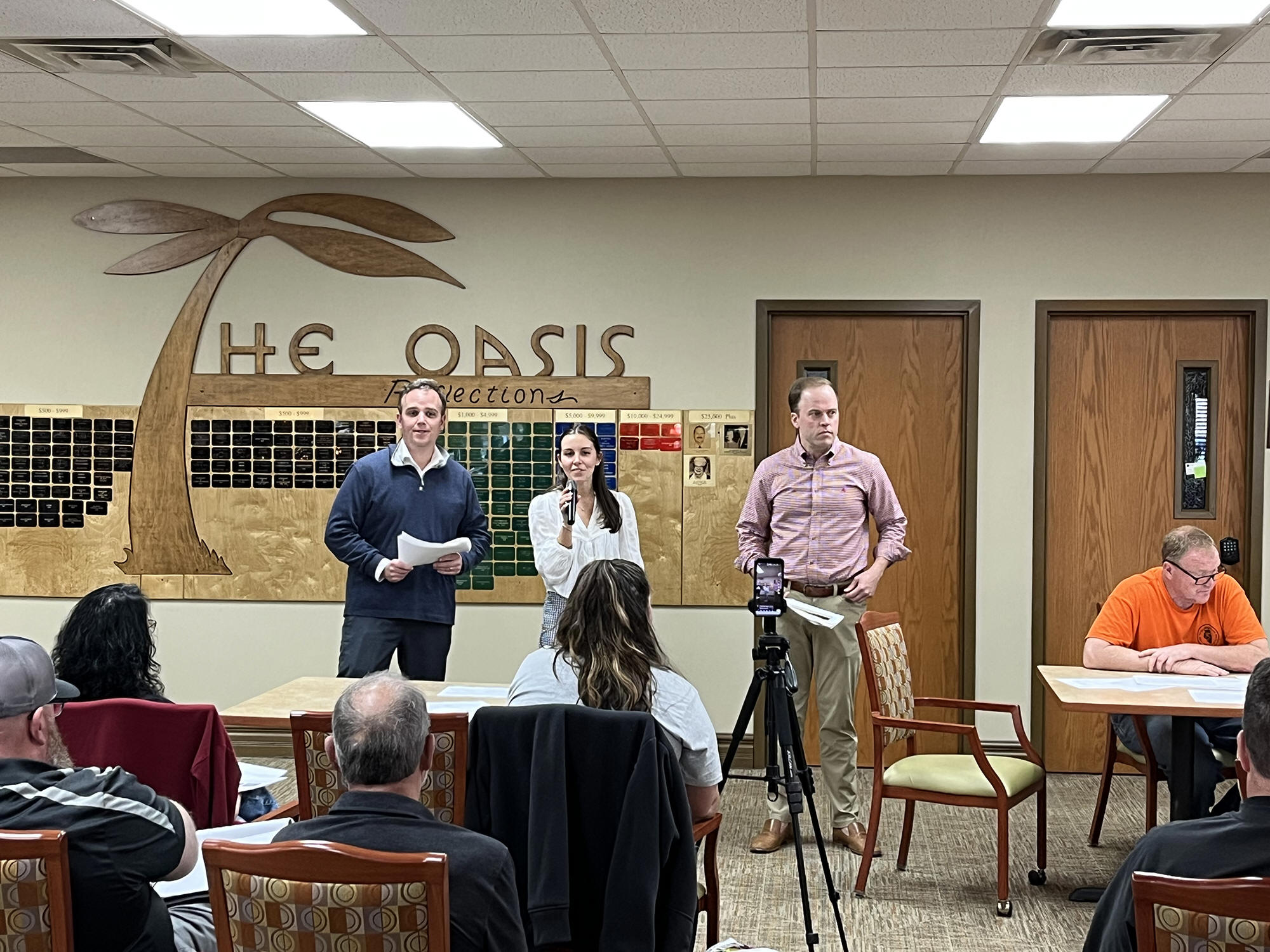
representatives to give their presentation. The three members
presenting were Peter Goehausen, Rylee Sevigny, and Greg Irwin.

The representatives started by
providing figures that have previously been given. They estimate the
creation of 200 full-time jobs, 1,500 union construction jobs, and
an estimated $65 million increase to tax revenue for Logan County.
They shared that they had signed a commitment with the county and
were willing to be held accountable to, the $65 million, 100 “Hut 8
sponsored jobs,” 9,000 gallon per day water usage limit, following
state and federal environmental laws, and creating a decommissioning
plan for when and if the site would be closed.
With the tax revenue, Irwin stated they were willing to, should
whatever tenant move into the site pay less than that estimated
amount, Hut 8 would cover the difference, agreeing that the county
would receive that amount each year regardless of who was in the
facility. They also gave a breakdown of where that money would go.
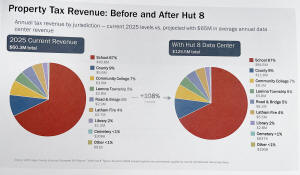
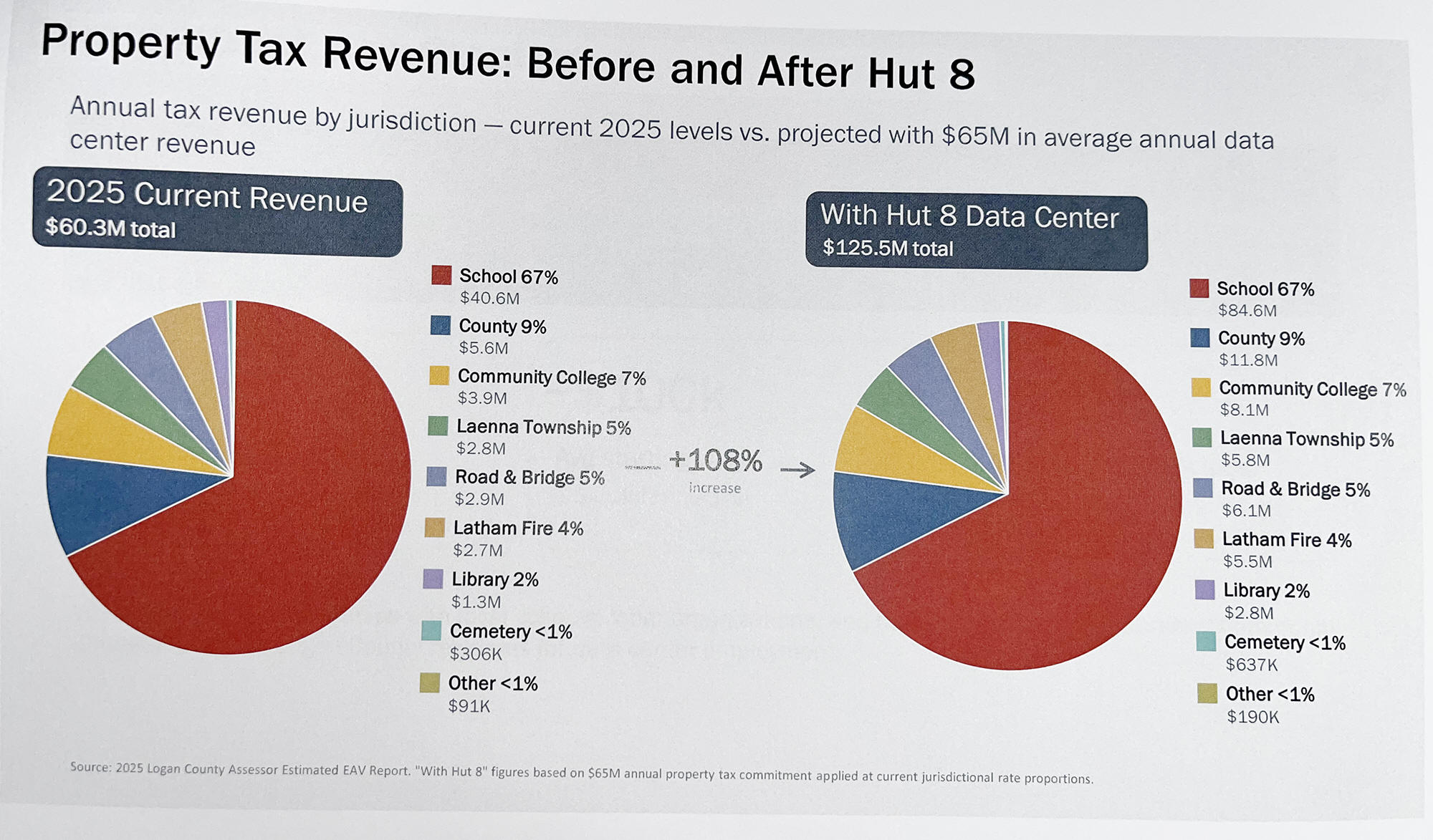
The 2025 tax revenue for Logan
County is just over $60 million, with Hut 8 stating that their
additional revenue would put the county at $125.5 million per year.
They provided pie charts with breakdowns of where that money would
go and in what amounts, as it is currently distributed. According to
Hut 8’s data, schools would increase from $40.6 million to $84.6
million and the county would go from $5.6 million to $11.8 million.
See the above photo for the complete breakdown of the tax figures.
As for the jobs, they stated they were willing to commit to 100, but
expect 200 full-time jobs. Aaron Gurnsey of Central Illinois
Building and Construction Trades Council spoke on the jobs stating
that there were thousands of union families in the Central Illinois
area that would benefit from this work if there were not enough
union workers in Logan County to fill all 1,500 jobs during
construction. He was asked if any of the laborers of these union
families were unemployed and looking for work. Guernsey stated that
their unemployment was low at the moment, but that that could change
at any time, calling their work “cyclical.”
This question led to many more questions being asked even though it
was not the time for public comments. A woman asked the Hut 8
representatives what provisions they were going to put in place to
make all the commitments they were agreeing to enforceable. She
stated that she wanted to know that these were promises the people
of the county could make Hut 8 keep and not simply a piece of paper.
Irwin started answering this question by stating that, should Hut 8
not pay the taxes they agreed to, their property would be considered
abandoned and would be shut down. Nelson then spoke, stating that
they could put a lot of these promises in a conditional use permit.
This permit would give the county a way to hold Hut 8 responsible
should they not keep all the commitments that they agreed to.
Irwin stated that not keeping their agreements would also hurt their
reputation. He stated that, should they build in Logan County, other
communities they would be looking to build in in the future would
contact Logan County to ask about their experience with Hut 8. Since
the company is wanting to build more data centers, this could hurt
their long-term goals of expanding.
Another woman then stated to the committee that they have an
ordinance for the wind turbines, and there is an issue with one of
them leaking oil that is not being addressed. Nelson assured her
that, since the issue was brought up, it has been addressed and is
currently in the process of being fixed.

Many other questions and comments
followed these. Some on the topic of noise pollution, some of the
energy they would be consuming, and concern that the kids of Latham,
who go to school outside Logan County, would not be benefitting from
the tax revenue this data center would generate. Goehausen informed
the woman asking that they have been meeting with the superintendent
of the Warrensburg-Latham school district to see what they could do
to benefit their students, specifically the ones from Latham.
[to top of second column] |

Another question was asked
regarding the wastewater of the closed loop system, with the
person asking if Hut 8 was going to “dump it in a creek
somewhere.” The Hut 8 representatives assured the person that
they would be working with a water treatment company that would
truck the water out to dispose of properly, according to state
law.
Around this time, Nelson tried to end the comments and
questions, stating that they could be saved for the public
comments section at the end. One of the women challenged this,
asking Nelson if community questions was not what the meeting
was for, and stating that she felt her questions were
“productive” and wanted to continue asking them. Nelson stated
that he would come back to the woman, opting to give the floor
to the committee members, and any other board members present.
Fellow board member Gil Turner was in the audience and wanted to
know about the $65 million traveling with whatever tenant that
Hut 8 brought into their facility and was informed that it
would. No other board or committee members had any other
questions, so Nelson allowed the woman to continue.
She asked questions about other data centers not complying with
their ordinances, 24-hour sound monitoring, and whether the
credit for decommissioning plan would still be good if the state
banned data centers. For the last question, Zoning and Economic
Development Officer Al Green answered. He stated that, even if
the state law was changed to allow data centers to have to do
less than what Hut 8 agreed to, Hut 8 would still be required to
do whatever they agreed to before the law change.
Another woman stood up and informed the committee that she and
others had accumulated 1,000 signatures for people opposing the
data center in the last month. She requested that a one-year
moratorium be placed on data centers in the county.
Nelson opened the floor to the committee for any motions.
Sanders made a motion for a 90-day moratorium. His rationale was
that they would give the people of the county just enough time
to meet the deadline of the first week of August to try to get
this issue placed on the ballot in November. The motion was
seconded by Kuhlman, which opened the floor for discussion on
the motion.

Nelson spoke for several minutes,
giving his rationale against any moratorium. He started by stating
that the board had been informed by Senator Sally Turner and
Representative William Hauter that there could be law change coming
through that would require counties to accept data centers, much
like the law states for wind and solar farms and will for battery
storage starting on June 1st. He then stated that there were
multiple data storage facilities “lined up” to build on the land if
Hut 8’s data center was not approved.

Nelson continued, stating that
Logan County is not bringing in much tax revenue at this time. This
being the case, he said that the county may have to increase
property taxes in a few years. Many of the concerns the community
has Nelson said he believes could be addressed with a conditional
use permit. He also argued that in 90 days, the state legislation on
data centers could change. If this were to be the case, Logan County
may have much less say over what they get out of a data center than
they do now.
He stated that at 90 days, Hut 8 would lose their spot in line with
Ameren. Previously, Irwin and Goehausen stated that Ameren would
only give them a limited time to make the payment for the
infrastructure upgrades that would be needed for their data center.
Usually, the bills of all Ameren customers would be increased to
cover the cost of Ameren having to make these upgrades. Hut 8,
however, is looking to pay that amount as to not have a direct
increase on local customers’ energy bills. Irwin stated that the cut
off for that payment would be in two weeks, saying that a moratorium
of any length would kill their project.
A vote was then taken on the motion to have a 90-day moratorium on
data centers. This motion passed 3-2, with Nelson and Schmidt being
the two ‘no’ votes. It should be noted that this vote does not mean
the moratorium is in effect. It simply means that it passed out of
committee, making a special regular board meeting necessary for the
full board to vote on it. Should it pass at that meeting, the
moratorium would be in effect. If it were to fail, then the
moratorium would not happen.
Nelson then opened the floor to public comments again, of which
there were several more. One was regarding the class action lawsuit
that Hut 8 was currently fighting. Another person wanted to know why
Nelson and Schmidt voted against the moratorium, and Nelson told her
that he would talk to her after the meeting. Another woman stated
that she felt Nelson’s comments about a battery storage facility for
sure coming if the data center was not built was “disingenuous.”
After a few other comments, the meeting was adjourned.
[Matt Boutcher]
|